For all the technological upheaval that has transformed British life over the past three decades, the machinery through which people find their way into work remains surprisingly familiar :
- A teenager is asked what they want to become.
- A graduate prepares a CV.
- A worker looking for something new searches through vacancies.
- An employer writes a job description, advertises it and attempts to select the right candidate from a pile of applications.
The newspaper classified advertisements was replaced by online jobs board, the Rolodex was replaced by the professional social network and the paper application became a digital form. Yet much of the underlying architecture survived the transition.
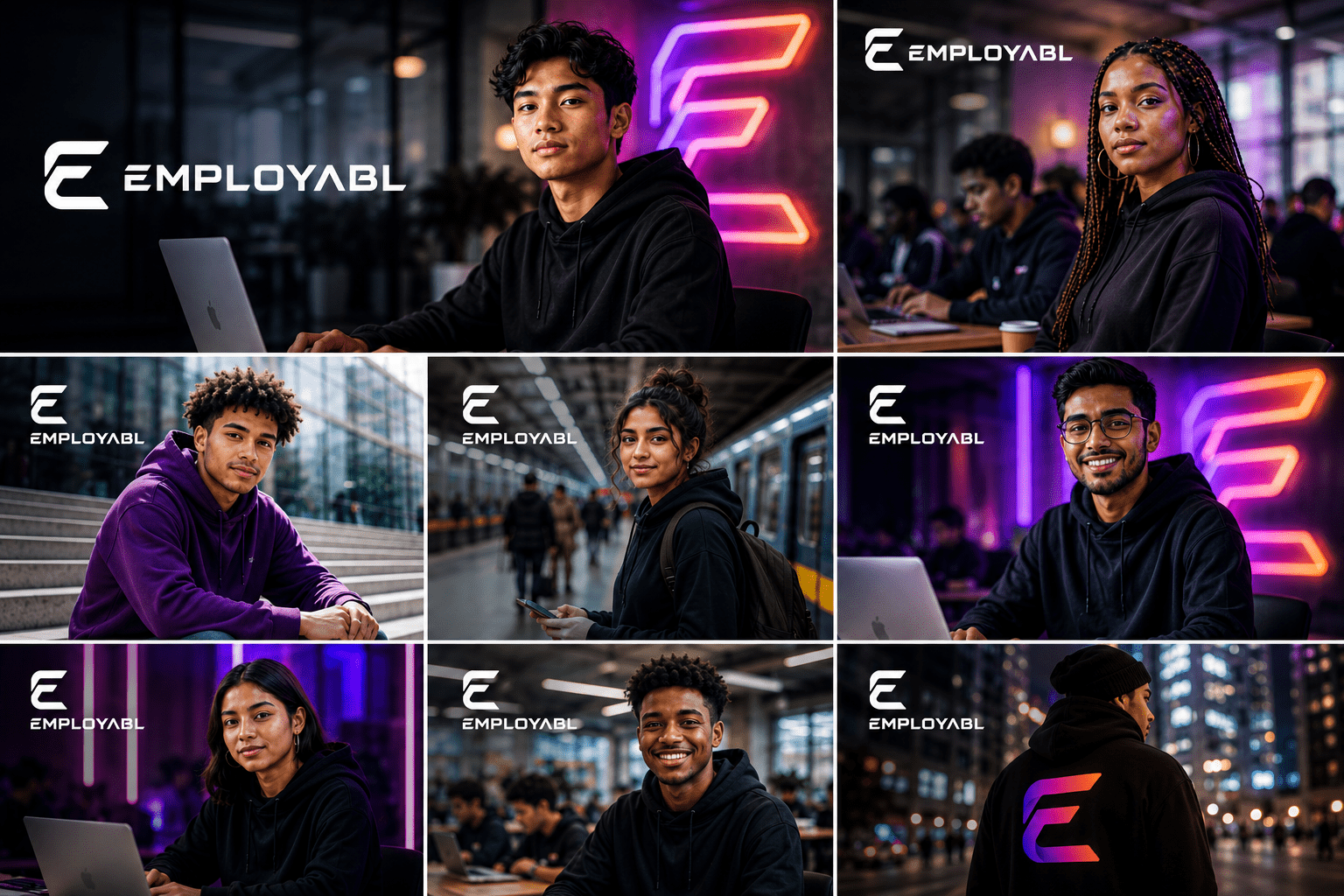
Omniscient AI is a British technology venture that thinks the next transformation will be considerably more fundamental. The company is developing what it describes as an AI-powered operating system for learning, careers and work, intended to accompany an individual from their first serious decisions about education and employment at 16 through potentially four or five decades of working life.
It is an unusually expansive proposition. EMPLOYABL does not want merely to help people find jobs. It wants to understand the individual, understand the labour market, understand employers and then continuously connect the three as circumstances change. If successful, it could turn the conventional employment model on its head.
Instead of asking somebody to repeatedly search for opportunity, opportunity would increasingly find them.
EMPLOYABL WILL MAKE THE CV OBSOLETE
At the heart of EMPLOYABL is a challenge to one of recruitment’s most enduring technologies: the curriculum vitae. The CV has survived because it is simple, portable and universally understood. It also represents a remarkably crude representation of a human being.
Two pages of education, employers, dates and job titles reveal relatively little about how somebody thinks, what motivates them, the environment in which they perform best, what transferable capabilities they possess or what they might be capable of becoming.
This becomes particularly problematic at the beginning of a career. A 17-year-old may possess considerable potential but almost no conventional employment history. It is equally problematic later in life, when somebody with 25 years of experience attempts to move into an industry where their previous job titles have little obvious relevance.
EMPLOYABL’s proposed answer is its Work DNA™ platform, a living digital representation of an individual’s skills, capabilities, interests, experience, aspirations, preferences and potential. Rather than being written once and periodically updated, it is intended to evolve. Education adds to it. Work experience adds to it. Volunteering adds to it. Qualifications, assessments, projects, employment and newly acquired skills add to it. Eventually, the picture of the individual becomes richer than the conventional CV could ever hope to be.
On the other side of the equation sits Employer DNA™. The same technology attempts to understand what an organisation actually needs: not simply the qualifications written into a job description, but the capabilities, characteristics, working environment and culture associated with success. The interesting part comes when artificial intelligence begins comparing the two.
EMPLOYABL IS REDEFINING HOW PROFESSIONALS AND EMPLOYERS CONNECT, GROW AND WORK
Consumer technology has conditioned people to expect extraordinary levels of personalisation and is demonstrated by the following :
- Spotify: learns what somebody listens to and discovers music for them.
- Netflix: predicts what they may want to watch.
- Amazon: anticipates what they may buy.
- TikTok: recommendation engine can understand interests with unsettling speed.
Yet a decision as consequential as a career remains remarkably dependent on the individual knowing what to type into a search box.
EMPLOYABL sees that as an anomaly. If technology can understand somebody’s taste in music after a few hours, why should it not become progressively better at understanding the work in which they might excel after years of interaction? The analogy is imperfect — careers carry consequences that entertainment recommendations do not, and AI-led employment decisions demand transparency, privacy safeguards and protection against bias. But the direction is significant.
The next generation of career technology is unlikely to wait for people to search. It will recommend, predict, navigate and increasingly act.
BUILDING A GOOGLE MAPS FOR WORKING LIFE
Google Maps does not simply tell a traveller where the destination is. It understands where they are now, where they want to go and the possible routes between the two.
Careers rarely work that way. A person knows where they are and may know broadly where they would like to be, but the steps connecting the two are scattered among universities, colleges, apprenticeship providers, recruitment sites, employers, training organisations, government programmes and careers services.
EMPLOYABL wants to connect those dots. For a 16-year-old, the route might move from school to work experience, a qualification, an apprenticeship and then employment. For a graduate it might connect an existing degree with a missing technical skill and an employer seeking precisely that combination. For somebody in their forties whose profession is being disrupted by artificial intelligence, the system could identify adjacent occupations in which much of their existing experience remains valuable and show what additional training would bridge the gap.
For somebody approaching 60, it could be something different again: consultancy, flexible employment, entrepreneurship, mentoring, retraining or a second career.
The significance of the model is therefore not simply matching. It is navigation.
Britain’s current careers infrastructure largely waits for individuals to decide what they want and then helps them search for it. The Employabl intelligent opportunity graph continually examines where somebody is, what is changing around them and where they could go next. That is closer to a navigation system for working life than a recruitment website.
A CAREER IDENTITY THAT BELONGS TO THE INDIVIDUAL
EMPLOYABL’s intention is that a person’s verified qualifications, capabilities, assessments, work experience, volunteering, projects and achievements should travel with them. This matters because enormous quantities of economically useful information currently disappear between institutions. A student completes a project at school, undertakes voluntary work, develops leadership skills through sport, takes an online course and spends a summer gaining work experience. When that individual applies for their first job, much of this is compressed into several lines on a CV. A worker encounters the same problem decades later. Twenty years of accumulated knowledge can become little more than a sequence of job titles.
EMPLOYABL is effectively proposing a persistent digital career identity: something that becomes more valuable the longer somebody uses it.
That has important implications for employers too. If the system can reliably verify what people can actually do, organisations could begin recruiting more on capability and potential and less on proxies such as previous employer, university attended or exact job title. The prize is a labour market in which talent currently hidden by the limitations of conventional recruitment becomes visible.
AN AI CAREERS COACH
The most ambitious component of EMPLOYABL is its proposed AI Career Coach™.
For decades, personalised career management has largely been a privilege. Senior executives employ coaches and headhunters. Wealthier families can purchase specialist educational and careers advice. Most people receive considerably less support. Generative AI creates the possibility of changing the economics of that equation.
An AI careers coach capable of understanding a person’s Work DNA, employment history, qualifications, aspirations and preferences could theoretically remain with that individual for decades. It would know what they had done. It would know what they could do. More importantly, it could begin to understand what they might do next.
A useful career coach would not simply answer questions. It could identify that demand for a person’s current skills was changing, highlight emerging occupations, recommend the specific training required to become eligible for them and surface employers already looking for those capabilities.
EMPLOYABL ultimately wants to go further still. Its proposed Apply for Me technology moves the system from advice towards agency. With the individual’s permission and appropriate controls, an AI career coach could identify suitable opportunities, prepare applications and potentially manage elements of the employment journey. At that point the comparison with a jobs board becomes increasingly irrelevant.
MERCHANT & STONE IS INVESTING IN THE TEAM BEHIND EMPLOYABL
EMPLOYABL is being invested in and developed by Merchant & Stone, whose interest in the project stems from the belief that AI is about to alter not merely recruitment but the economics of human potential.
For Ajaz Sulaman, Director of Merchant & Stone, the fundamental opportunity lies in connecting systems that have historically operated independently.
“The next breakthrough in employment will not come from building a better jobs board. It will come from building an intelligence layer between people, education, skills and opportunity.”
“EMPLOYABL is designed to understand the individual continuously — their Work DNA™, skills, experience, ambitions and potential — while AI simultaneously maps a constantly changing world of jobs, apprenticeships, training and emerging industries. Instead of searching thousands of opportunities, the system begins to predict which opportunities matter to you.”
“Imagine entering EMPLOYABL at 16 and building a living digital model of your working potential that evolves throughout your life. At 25, it understands where your career could go next. At 40, it can identify skills you didn’t realise were transferable into industries that may not have existed five years earlier. At 60, it can help design the next chapter of your working life.”
“For half a century, recruitment technology has essentially digitised the same idea: people search for opportunities. AI allows us to invert that model. If you can understand the individual deeply enough, and map the opportunity economy in real time, the right opportunities can start finding the right people.”
“That is the thesis behind EMPLOYABL. We are not trying to make recruitment 10% better. We are building towards an AI-powered operating system for working life — and asking whether the recruitment model we inherited is becoming obsolete.”
Ajaz Sulaman, Merchant & Stone